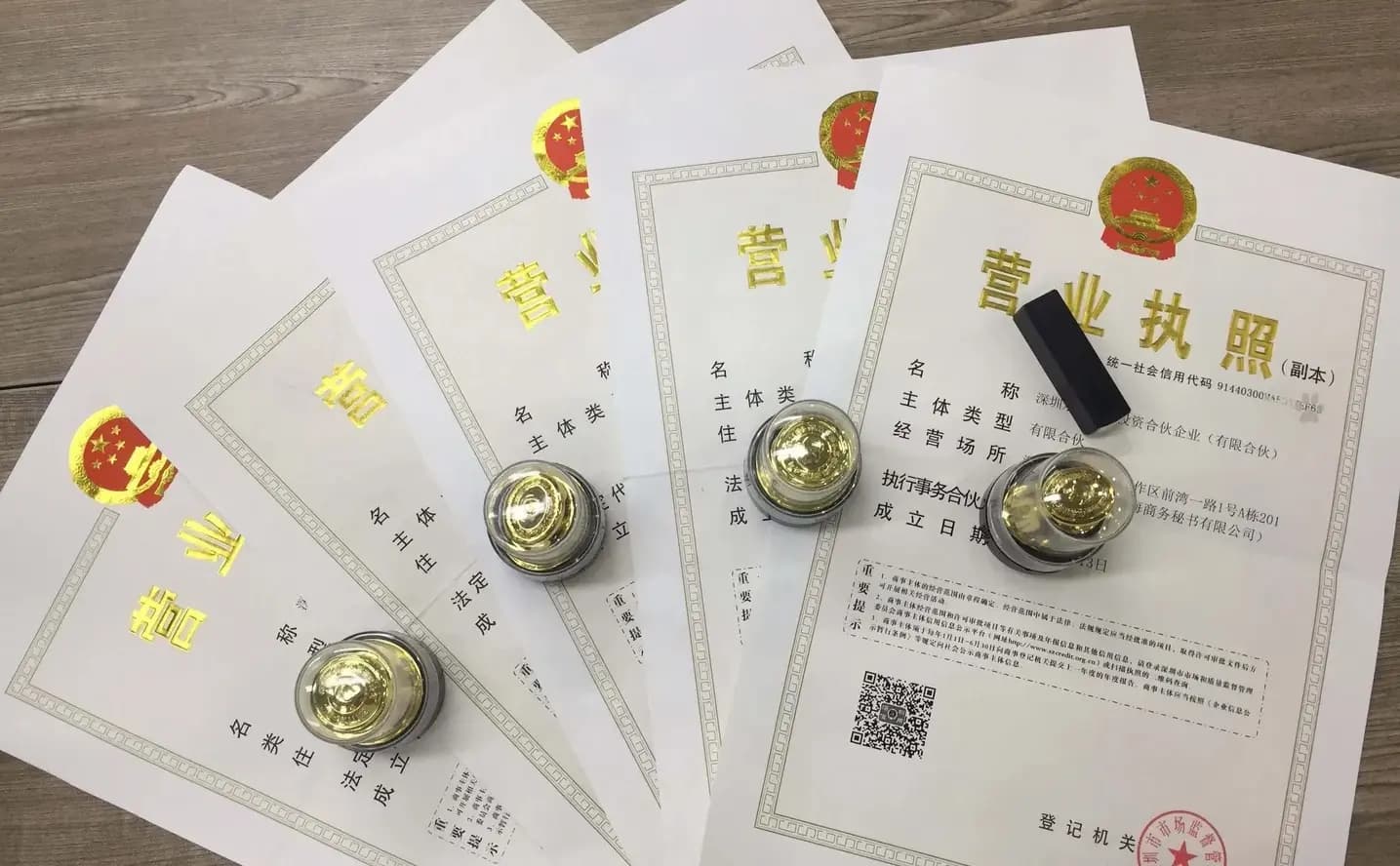
Establish a Chinese Company
Open a mainland company remotely for Hong Kong people and foreigners
Chinese Business served by Hong Kong Services
Years of experience in both places
More than 8 years of domestic operation experience, providing you with the most Hong Kong-style consulting services
Shenzhen Office
The self-operated Shenzhen team handles your personal information independently. 3rd party agents are not involved
Full Services by Hong Kong Manager
Well aware of the differences in culture and rules and regulations between the two places, your Hong Kong customer service manager will be responsible for the entire process and the mainland team will execute it. English communication
Service Process
Name pre-approval
Check the company name for duplication and obtain pre-approval
Commerce department filing
Non-restricted industries are handled by filing/record, not individual approval
Business registration
Submit the business registration application and obtain the business license
Seal engraving
Make the company seal, financial seal, legal representative seal and invoice seal
Bank account opening
Open a mainland bank account for the company
Tax registration
Complete national and local tax registration
The entire process generally takes 1.5-2 months, depending on the region and industry
Registration Locations
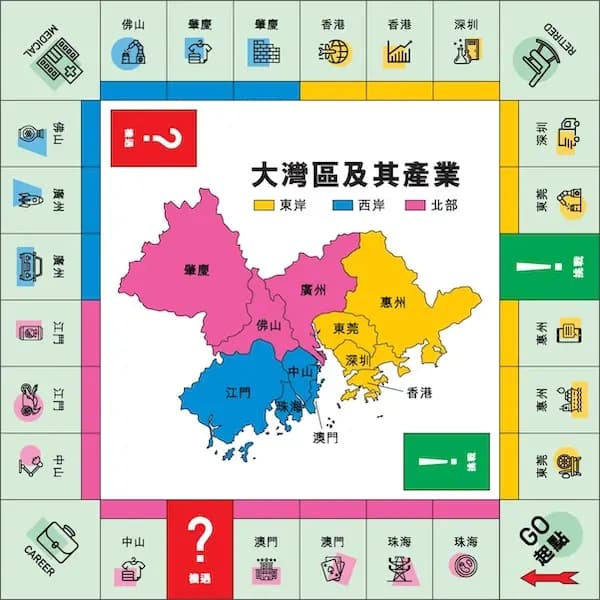
Basic corporate services are identical across Shenzhen, Qianhai and Guangzhou — actual fees vary by location and case
Shenzhen
Tech and manufacturing hub, adjacent to Hong Kong
Qianhai
Shenzhen free-trade zone with preferential policies
Guangzhou
Provincial capital, trade and logistics hub
What's Included
- Name plagiarism check and pre-approval
- Project approval certificate and documents
- Business licence application
- National and local tax registration
- Enterprise code certificate
- First-year accounting and tax filing service
- Company seal creation
First-year accounting is included — mainland entities face monthly filing obligations from day one, a materially heavier cadence than Hong Kong's annual cycle.
Check industry restrictions first, then budget
China maintains a negative list restricting or prohibiting foreign investment in certain sectors — this should be the first conversation, not an afterthought. We also offer profit repatriation, employee compliance consultation and company deregistration support; actual fees vary by case, so please contact us for a quotation.
WhatsApp for a QuoteOr send us an enquiry
FAQ
Can Hong Kong companies conduct business in mainland China? Do they need to register a Chinese company?
Main methods include:
- Establish a Wholly Foreign-Owned Enterprise (WFOE) - This is the most common method, where a Hong Kong company acts as a foreign shareholder to establish a wholly-owned or joint venture enterprise in mainland China
- Establish a representative office - Can only engage in non-profit activities such as liaison and market research, cannot directly conduct business
- Cross-border e-commerce - Trade through cross-border e-commerce platforms without registering an entity in mainland China
- Appoint agents - Commission mainland Chinese companies to act as sales or procurement agents
We recommend choosing the most suitable method to enter the mainland market based on your specific business needs, and we can assist you in completing the relevant registration procedures.
What are the requirements for registering a company in China?
Shareholder requirements:
- At least 1 shareholder (can be individual or company)
- Foreign shareholders can be Hong Kong companies, overseas companies or foreign individuals
- No nationality restrictions for shareholders
- At least 1 director (can be one of the shareholders)
- Directors can be foreign nationals or Chinese citizens
- No residency restrictions
- Must appoint 1 legal representative
- Legal representative needs to provide contact information within China
- Usually held by director or general manager
- No minimum registered capital requirement (most industries)
- Registered capital can be paid in installments
- Certain special industries (such as finance, construction) have minimum capital requirements
- Must have an actual business address in China
- Need to provide lease contract and property ownership certificate
- Address must be for commercial use (cannot be residential)
- Need to clearly list the company's business scope
- Some industries require special approvals or licenses
- Business scope will affect tax and regulatory requirements
What is the tax system for Chinese companies?
Corporate income tax:
- Standard rate - 25%
- Preferential rate for small low-profit enterprises - For annual taxable income not exceeding RMB 1 million, 12.5% is included in taxable income and taxed at 20% (effective rate 2.5%); for the portion exceeding RMB 1 million but not exceeding RMB 3 million, 50% is included and taxed at 20% (effective rate 10%)
- High-tech enterprises - 15% preferential rate
- General taxpayers - Tax rates of 6%, 9% or 13% (depending on industry)
- Small-scale taxpayers - Levy rate of 3% (can be reduced to 1% in some cases)
- Can deduct input VAT
- Individual income tax - Employee wages require withholding, progressive rates of 3%-45%
- Urban maintenance and construction tax - 7% of VAT (urban areas) or 5% (counties, towns)
- Education surcharge - 3% of VAT
- Local education surcharge - 2% of VAT
- Stamp duty - 0.03%-0.1% of contract amount
- VAT - Monthly or quarterly filing
- Corporate income tax - Quarterly prepayment, annual final settlement
- Individual income tax - Monthly filing
- Additional deduction for R&D expenses - 75%-100%
- Accelerated depreciation of fixed assets
- Preferential policies in specific regions (such as free trade zones, special economic zones)
What should be noted when employing staff in China?
Employment contract:
- Must sign - Must sign written employment contracts when hiring employees
- Contract term - Fixed term, non-fixed term, or term based on completion of specific work tasks
- Probation period - Maximum 6 months, depending on contract term
- Contract content - Must include job content, work location, working hours, remuneration, social security, etc.
- Five insurances and one fund - Pension insurance, medical insurance, unemployment insurance, work injury insurance, maternity insurance, housing provident fund
- Mandatory contribution - Enterprises must contribute social security and housing fund for employees
- Contribution ratio - Enterprises bear approximately 30-40%, individuals bear approximately 10-20% (ratios vary slightly by region)
- Contribution base - Determined based on employee's average monthly salary in previous year
- Minimum wage - Cannot be lower than local minimum wage standard
- Overtime pay - 1.5 times for weekday overtime, 2 times for weekends, 3 times for statutory holidays
- Annual leave - Entitled to 5-15 days paid annual leave after working for 1 year
- Statutory holidays - Approximately 11 statutory holidays per year, wages must be paid
- Standard hours - 8 hours per day, 40 hours per week
- Overtime limits - Daily overtime not exceeding 3 hours, monthly not exceeding 36 hours
- Rest days - At least 1 rest day per week
- Legal grounds - Need legal grounds for dismissal (such as serious misconduct, incompetence, etc.)
- Economic compensation - No-fault dismissal requires payment of economic compensation (1 month's salary for each full year worked)
- Advance notice - Usually requires 30 days written notice or additional payment of 1 month's salary
- Work permit - Foreign employees need to apply for work permit and work-type residence permit
- Application requirements - Need to meet education, work experience and other requirements
- Processing time - Approximately 1-2 months
Which industries are restricted in China or require special approvals?
Prohibited industries (foreign capital cannot invest):
- Rare earth smelting
- Production and wholesale of tobacco products
- Social surveys
- Chinese legal affairs consulting (excluding provision of international law and foreign law information consulting)
- Telecommunications services - Foreign capital ratio not exceeding 50%
- Internet information services - Foreign capital ratio not exceeding 50%, requires special approval
- Education services - Compulsory education, military education, etc. prohibit foreign capital, other education services require Chinese controlling stake
- Medical services - Requires health department approval
- Publishing, news, broadcasting - Prohibited or strictly restricted for foreign capital
- Financial services - Banking, insurance, securities, etc. require special licenses and approvals
- Food production and sales - Requires food business license
- Pharmaceuticals and medical devices - Requires pharmaceutical business license or medical device business license
- Import and export trade - Requires import and export rights filing
- Road transportation - Requires road transportation business license
- Labor dispatch - Requires labor dispatch business license
- Human resources services - Requires human resources service license
- High-tech industries
- Advanced manufacturing
- Modern service industries
- Energy conservation and environmental protection industries
- R&D centers
Recommendation: Before determining business scope, it is recommended to consult professional advisors to confirm whether your industry is restricted and what special approvals or licenses are needed. We can assist you in assessing industry entry conditions and handling relevant licenses.
What is a WFOE (Wholly Foreign-Owned Enterprise)? How does it differ from other types of Chinese companies?
Main features of WFOE:
- 100% foreign ownership - No need for Chinese partners, completely controlled by foreign capital
- Independent legal person - Has independent legal person status in China and can operate independently
- Limited liability - Shareholders' liability is limited to their capital contribution
- Autonomous operation - Can make decisions, manage and operate independently
- Can issue invoices - Can issue Chinese VAT invoices and conduct normal business activities
- Sino-foreign joint venture (JV) - Requires Chinese partners, shared equity, decisions need bilateral consultation
- Representative office - Cannot directly operate, can only engage in non-profit activities such as liaison and market research, cannot issue invoices or employ staff (except chief representative)
- Individual business - Suitable for small businesses operated by individuals, unlimited liability
WFOE is suitable for foreign enterprises hoping to develop long-term in China and requiring complete control and independent operation.
How long does it take to register a Chinese company? What are the costs?
Processing time:
- Name pre-approval - Approximately 3-5 working days
- Commerce department filing - Approximately 10-15 working days
- Business registration - Approximately 5-7 working days
- Seal engraving - Approximately 2-3 working days
- Bank account opening - Approximately 10-15 working days
- Tax registration - Approximately 3-5 working days
Service fees: We offer WFOE registration in Shenzhen, Qianhai and Guangzhou, covering name approval, business registration, seal engraving (company seal, financial seal, legal representative seal, invoice seal), first-year bookkeeping and tax filing, bank account opening assistance and tax registration. Actual fees depend on the location, industry complexity and address arrangements — there is no flat rate, and we provide a detailed quotation once we understand your case.
Subsequent costs: Bookkeeping, annual audit, and employee social security and housing fund contributions (if you hire staff), which vary with company size and headcount. Social insurance is often underestimated, so plan for it early.
Contact us for a detailed quotation.
Do Chinese companies need to conduct audits and annual inspections?
Annual audit:
- Statutory audit - All enterprises must conduct financial statement audits annually
- Audit report - Must be issued by Chinese certified public accountants
- Audit timing - Usually conducted in March-May each year for the previous year
- Audit content - Includes balance sheet, income statement, cash flow statement, etc.
- Report period - January 1 to June 30 each year
- Report content - Basic enterprise information, shareholder information, asset status, social security information, etc.
- Publicity requirement - Annual report information will be published on the National Enterprise Credit Information Publicity System
- Consequences of late reporting - Will be listed in the abnormal operation directory, affecting enterprise reputation and business development
- Filing deadline - Complete previous year's corporate income tax final settlement by May 31 each year
- Filing content - Adjust annual taxable income, calculate tax payable or refundable
- Documents to submit - Annual financial statements, audit report, final settlement return
- Social security and housing fund annual inspection - Need to report and adjust contribution base annually
- Statistical annual report - Some enterprises need to submit annual statistical data to statistics departments
- Foreign exchange annual inspection - Enterprises with foreign exchange business need to conduct foreign exchange annual inspection
We provide one-stop audit, annual report and tax filing services to ensure your company operates in compliance.
Can Chinese companies repatriate profits to Hong Kong?
Conditions for profit repatriation:
- Complete tax filing - Must complete annual corporate income tax final settlement
- Provide audit report - Need to provide audited financial statements
- Board resolution - Pass board resolution for profit distribution
- Taxes paid - Have paid all corporate income tax due
- Board resolution - Pass profit distribution resolution, determine distribution amount
- Tax filing - Report profit distribution to tax bureau, pay withholding income tax
- Bank application - Submit profit repatriation application and related documents to bank
- Foreign exchange registration - Complete foreign exchange registration procedures
- Remittance - Bank remits to overseas account after approval
- Standard rate - 10%
- Hong Kong company preferential rate - According to the "Arrangement between the Mainland of China and the Hong Kong Special Administrative Region for the Avoidance of Double Taxation and the Prevention of Fiscal Evasion with respect to Taxes on Income", can enjoy 5% preferential rate if conditions are met
- Application requirements - Need Hong Kong tax resident certificate issued by Hong Kong Inland Revenue Department
- Board resolution
- Audit report
- Tax payment certificate
- Hong Kong company business registration certificate
- Hong Kong tax resident certificate (if applying for preferential rate)
- Other documents required by bank
- Can only remit after-tax profits, cannot remit registered capital
- Need to retain sufficient statutory reserve fund (10% of after-tax profits)
- Remittance amount must be consistent with audit report and tax filing
- Recommend advance planning to ensure all documents are complete
Can Chinese companies be deregistered? What is the deregistration procedure?
Common reasons for deregistration:
- Business termination or transfer
- Shareholders decide to dissolve company
- Company merger or division
- Business term expires
- Business license revoked or ordered to close by law
Step 1: Establish liquidation group (approximately 5-7 working days)
- Shareholders' meeting resolution to dissolve company
- Establish liquidation group and file with business administration department
- Publish liquidation announcement in newspaper or National Enterprise Credit Information Publicity System
- Clear company assets, prepare balance sheet and asset inventory
- Notify and announce to creditors
- Handle company's unfinished business related to liquidation
- Pay off owed taxes and taxes generated during liquidation
- Clear creditor's rights and debts
- Handle remaining assets after company settles debts
- Represent company in civil litigation
- Apply to tax bureau for tax deregistration
- Submit liquidation report and tax liquidation statement
- Pay all taxes and penalties
- Surrender invoices and tax control equipment
- Obtain tax deregistration certificate
- Submit deregistration application to business administration department
- Submit liquidation report, tax deregistration certificate and other documents
- Surrender business license
- Obtain deregistration notice
- Bank account deregistration
- Social security account deregistration
- Housing fund account deregistration
- Customs deregistration (if have import/export rights)
- Seal destruction
Deregistration costs: Including liquidation audit fees, publication fees, professional service fees, etc., which vary by case — contact us for a quotation.
Notes:
- Must settle all debts and taxes
- Employees need proper placement and payment of economic compensation
- Companies that have not filed annual reports on time or have other violation records need to first remove abnormal status before deregistration
- If company has pending litigation, need to wait until litigation ends before deregistration
We provide full company deregistration services, including liquidation, tax deregistration, business deregistration, etc., to assist you in smoothly completing the deregistration procedure.