[2026 Latest] Complete Guide for Mainland Chinese to Set Up a Company in Hong Kong — Procedures, Costs, and Considerations
2026-02-12 | Chinglink Business, Licensed TCSP (TC009047) · Last reviewed 2026-09-15
Complete Guide for Mainland Chinese to Set Up a Company in Hong Kong — Procedures, Costs, and Considerations
With the development of the Greater Bay Area and the deepening economic integration between Mainland China and Hong Kong, more and more mainland entrepreneurs are turning their attention to Hong Kong, an international financial center. As a bridge connecting Mainland China and the global market, Hong Kong offers a free and open economic policy, a simple tax system, and a robust legal framework, providing an ideal platform for mainland businesses to go global.
This article provides a comprehensive guide for mainland entrepreneurs to set up a company in Hong Kong, covering company type selection, registration procedures, cost analysis, bank account opening, and tax arrangements, helping you smoothly establish and legally operate a Hong Kong company.
Why Choose to Set Up a Company in Hong Kong?
For mainland entrepreneurs, setting up a company in Hong Kong offers multiple advantages:
- Tax Benefits: Hong Kong adopts a territorial tax system, imposing a 16.5% profits tax only on income derived from Hong Kong, with no tax on overseas income; there is no VAT, sales tax, or capital gains tax.
- Free Trade Environment: Hong Kong is one of the freest economies globally, with no restrictions on capital flows and relaxed foreign exchange controls.
- International Business Reputation: Hong Kong companies are widely recognized internationally, facilitating overseas market expansion.
- Robust Legal System: Hong Kong has a common law-based legal system, providing strong protection for intellectual property and commercial contracts.
- Convenient Banking Services: Hong Kong has a well-established international banking network, making global business transactions easier.
- Gateway to International Markets: Hong Kong is an ideal platform for mainland businesses to "go global" and a bridgehead for foreign investment into the mainland market.
Types of Hong Kong Companies
The most common company form in Hong Kong is a private limited company. According to the Hong Kong Companies Registry, the Hong Kong Companies Ordinance (Chapter 622) primarily regulates the following types of companies:
- Private Limited Company: The most common type, with shareholders' liability limited to their shareholding, and the company name must end with "Limited" or "有限公司."
- Public Limited Company: Can issue shares to the public, suitable for businesses preparing to list.
- Company Limited by Guarantee: Mainly used for non-profit organizations.
- Unlimited Company: Shareholders have unlimited liability for company debts, rarely used.
- Registered Non-Hong Kong Company: Branches of foreign companies in Hong Kong.
For most mainland entrepreneurs, a private limited company is the most suitable choice.
Ready to set up a Hong Kong private limited company? See pricing and the process at Chinglink's Hong Kong limited company service.
🚀 2026 Startup Acceleration Program:
For mainland Chinese establishing a company in Hong Kong, the biggest challenge isn't registration, but "opening a bank account". Chinglink has extensive pre-approval experience, assisting clients with connecting with major banks such as Bank of China and HSBC.
🎁 Limited-Time Offer: Inquire about our package now and receive a free "Preliminary Feasibility Assessment for Account Opening"!
💬 Consult an expert via WhatsApp
Hong Kong Company Registration Process
1. Company Name Search and Selection
First, you need to choose a name for your company. You can conduct a name search on the Hong Kong Companies Registry Integrated Information System to ensure your proposed name is not already registered. A company can have both Chinese and English names.
2. Prepare Registration Documents
To register a Hong Kong company, you need the following documents:
- Articles of Association
- Form NNC1 (Application for Company Registration)
- Business Registration Application These documents require basic company information, including:
- Company name
- Registered address (must be a Hong Kong address)
- Nature of business
- Share capital structure
- Director and shareholder details
- Company secretary details (must be a Hong Kong resident or a Hong Kong-registered company)
3. Submit Application and Pay Fees
You can submit your application electronically or in person at the Companies Registry. According to the Hong Kong Government's One-Stop Portal, registration fees include:
- Company registration fee: HKD 1,720 (discount for electronic submission)
- Business registration fee: Varies based on the chosen validity period (one or three years)
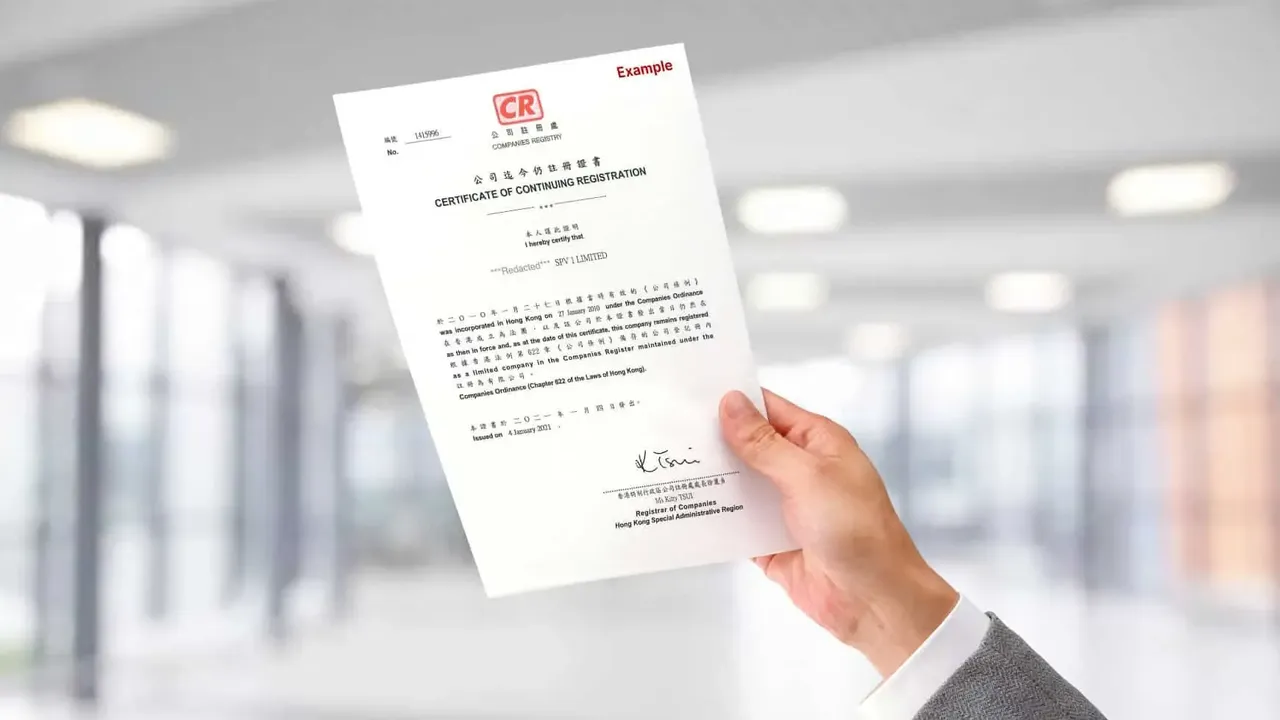
4. Obtain Company Registration Certificate and Business Registration Certificate
After submission, it typically takes about 3-5 working days (faster for electronic submissions) to receive:
- Company Registration Certificate
- Business Registration Certificate
Post-Registration Arrangements for Hong Kong Companies
1. Bank Account Opening
After establishing a Hong Kong company, opening a bank account is a crucial step. Recently, Hong Kong banks have tightened their requirements, and the necessary documents usually include:
- Company registration documents
- Business plan
- Proof of transaction background and fund sources
- Identity and address proofs for directors and major shareholders
- Contracts or correspondence with clients and suppliers It is advisable to understand specific bank requirements in advance, schedule an appointment, and have directors visit Hong Kong in person. According to the Hong Kong Monetary Authority, businesses should compare bank requirements and choose the most suitable one.
2. Company Secretary Services
Under Hong Kong law, every Hong Kong company must appoint a Hong Kong resident or a Hong Kong-registered company as its company secretary. The secretary's main duties include:
- Maintaining statutory records
- Handling annual returns
- Assisting with shareholder and director meetings
- Updating company information changes
- Arranging document signing and notarization For mainland entrepreneurs, hiring a professional company secretary service is the most convenient option.
3. Accounting and Audit Arrangements
Hong Kong companies must comply with the following accounting and audit requirements:
- Prepare financial statements per Hong Kong Institute of Certified Public Accountants standards
- Appoint an independent auditor for annual audits
- Submit profits tax returns to the Inland Revenue Department on time
4. Virtual Office Options
Many mainland entrepreneurs opt for virtual office services when starting a Hong Kong company, including:
- Providing a Hong Kong business address
- Mail forwarding services
- Call answering services
- Meeting room rentals When choosing a virtual office, consider location, pricing, services, and the provider's reputation.
Tax Obligations of Hong Kong Companies
1. Profits Tax
Hong Kong uses a territorial tax system, imposing profits tax only on income derived from Hong Kong. Current rates are:
- First HKD 2 million in profits: 8.25%
- Remaining profits: 16.5% Note: If your business income is entirely from outside Hong Kong and you can prove it to the Inland Revenue Department, you may qualify for offshore tax exemption.
2. Tax Filing
Hong Kong companies must file taxes annually:
- The first fiscal year usually receives the first profits tax return 18 months after incorporation
- Subsequent years require annual submissions
- Accurate reporting of income and expenses is mandatory
- Provide supporting documents for offshore income if applicable
3. Employee Taxes
If the company has employees in Hong Kong, it must:
- File taxes for employees
- Submit employer tax returns
- Arrange Mandatory Provident Fund contributions if applicable
Special Considerations for Cross-Border Business Between Mainland and Hong Kong
1. Cross-Border Tax Planning
Mainland businesses setting up in Hong Kong should pay special attention to tax arrangements between the two regions:
- Utilize the Mainland-Hong Kong Double Taxation Avoidance Agreement to reduce tax costs
- Be aware of the mainland's "place of effective management" criteria to avoid Hong Kong companies being treated as mainland tax residents
- Arrange transaction models and contract locations to ensure tax compliance
2. Foreign Exchange Management
Mainland businesses conducting international operations through Hong Kong companies must understand mainland foreign exchange regulations:
- Register outbound investments
- Comply with cross-border fund flow regulations
- Stay updated on foreign exchange policy changes
3. Compliance Risk Management
Operating a Hong Kong company requires compliance with both regions' laws:
- Adhere to anti-money laundering and counter-terrorism financing requirements
- Comply with Hong Kong Companies Ordinance regulations
- Maintain good corporate governance
Frequently Asked Questions
Can Mainland Residents Directly Serve as Directors of Hong Kong Companies?
Yes, mainland residents can serve as directors of Hong Kong companies without residency or work visa restrictions. However, identity and address proofs are required.
Do Hong Kong Companies Need Substantial Business Operations?
While Hong Kong law does not mandate "substantial business" for company setup, it is crucial for tax and banking purposes. Tax authorities and banks review actual operations for offshore exemption or account maintenance.
Are Shareholder Details Public?
Director details are publicly searchable at the Companies Registry, but shareholder details, though registered, are not usually public. For privacy, nominee shareholder arrangements can be considered.
Must I Visit Hong Kong in Person to Register a Company?
No. Mainland entrepreneurs can delegate registration to professional company secretary services. However, most Hong Kong banks require directors to be present for account opening.
Can a Hong Kong Company Operate in Mainland China?
A Hong Kong company must establish a foreign-invested enterprise per mainland regulations to conduct substantive business in China. It cannot operate directly but can invest in mainland companies as a holding entity.
If you need an operating entity in mainland China, consider registering a mainland company alongside your Hong Kong one — see Chinglink's China company registration service.
Conclusion
Setting up a company in Hong Kong is a vital step for mainland entrepreneurs expanding globally, but it requires understanding both regions' laws and business environments. This guide aims to provide clear directions for mainland entrepreneurs looking to start a business in Hong Kong, helping you embark on international operations smoothly.
In the complex cross-border business environment, seek professional company secretary, accountant, and lawyer assistance to ensure legal compliance and maximize Hong Kong's advantages as an international business platform.
Whether you're a first-time entrepreneur or an established business expanding globally, this guide offers practical insights for your Hong Kong business journey.
Questions about this?
Talk to a licensed company secretary — no charge, no obligation.
Chat on WhatsApp